There is a quiet recategorisation happening inside Singapore's service economy. It is not being announced. It is not being covered by the local business press. It is visible only to the customers who have stopped going to traditional car detailers and started booking the same two people for the same standing slot, week after week, month after month, because what those two people sell is not actually car detailing.
What they sell is the absence of being lied to. The car gets clean as a side effect.
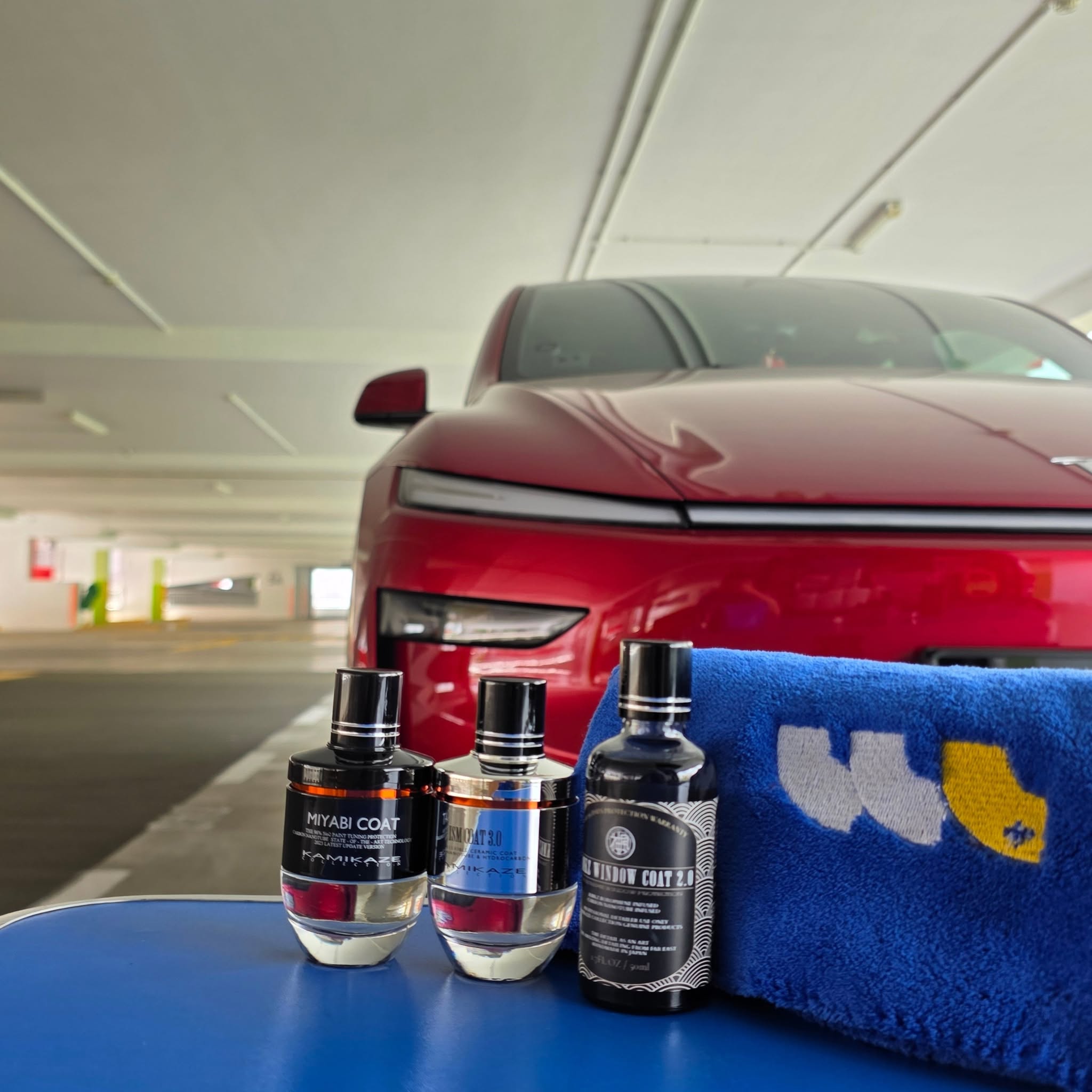
WashCar SG is a Singapore-based mobile car care operation founded in 2020 by Zaidi and Amirah, husband and wife. The model is straightforward. They come to the customer's location, anywhere in Singapore, with the full set of detailing equipment loaded into their van. They do the work in the customer's carpark or driveway. The customer does not travel. The customer does not wait in a queue. The customer is not handed back a car that looks acceptable from a distance but reveals problems on closer inspection.
On paper that is mobile car detailing, a service category that has existed in Singapore for at least fifteen years. There are dozens of operators offering versions of it.
What WashCar SG actually built is something different, and it took the slowing economy of the last eighteen months to reveal what it is.
Start with the operating philosophy. The brand promise is a sentence that nobody else in the Singapore detailing market would publicly commit to. We come. We care. We do not leave until it is right. That last clause is the one that matters. Most detailers operate on a fixed time block, finish the job within that block, and move to the next booking. If something was missed, the customer either notices later or does not. WashCar SG operates on the principle that the job is finished when the job is correct, not when the time runs out. In practice this means the operators stay until they are satisfied. In practice this also means they sometimes lose money on a difficult job because the job ran long. That is a structural choice, not a marketing claim.
Then there is the second decision that almost no operator in this category makes. WashCar SG tells customers when a service will not solve their problem. A customer calls about persistent odour. The honest answer in some cases is that fumigation will mask the smell but not eliminate the source, and the customer should investigate the source first. A customer calls about scratches that paint correction will not fully remove. The honest answer is that they should accept the limit, get a partial restoration, and adjust expectations. A customer calls for an interior detail that the existing condition does not justify spending money on. The honest answer is that a basic clean will do the same job for less.
Each of these honest answers costs the booking. Each of these honest answers builds the long-term position.
The economic logic is straightforward but rarely understood by competing operators. In a normal economy, the customer who is upsold and disappointed will probably come back anyway because switching costs feel high. In a slowing economy, that customer cuts the discretionary line item and never comes back. The operator who refused to upsell when it was easy is now the operator the customer keeps booking when money gets tight, because that operator has not yet given them a reason to feel cheated.
The Editor's Note
If you are reading this and the pattern fits your business — start the conversation before the conversation starts itself. editor@unpublished.my.
Singapore is now in the slowing economy. Consumer sentiment has tightened across discretionary categories through late 2025 and into early 2026. Service businesses across the island are seeing customer churn that did not exist eighteen months ago. The detailing operators that built their model on volume, upsell, and discount-led acquisition are seeing the bookings thin first. The operators that built a different kind of relationship are seeing those bookings hold.
WashCar SG holds. The customers who have used it for two years do not move to a cheaper competitor when budgets tighten. The customers who try it for the first time tend to return. The economics of the business are not built on aggressive customer acquisition. They are built on retention that approaches one hundred percent across the customers who have crossed the trust threshold.
That trust threshold is the variable competing operators do not understand. It is not built through marketing. It cannot be communicated through a website tagline or a campaign. It is built one job at a time, one honest conversation at a time, one come-back-and-fix-it visit at a time. Zaidi and Amirah have spent six years accumulating it across their customer base. A competitor cannot replicate it through a price war.
The come-back guarantee deserves a paragraph of its own. If a customer notices something was missed after WashCar SG leaves, the operators return to fix it at no extra charge. This is stated openly. It is also rarely invoked, because the operators do not leave problems behind in the first place. But the existence of the guarantee changes the customer's relationship with the brand permanently. The customer who knows their detailer will return at no cost if something is wrong does not need to obsess over the quality check at the moment of completion. They can let the operator do the work and trust the work. That trust compounds with every interaction.
The husband-and-wife structure also matters more than it appears. WashCar SG is not a brand built by an investor or a marketing team. The two people who answer the WhatsApp messages are the same two people who show up to do the work. The accountability is total. There is no employee to blame when something is missed. There is no head office to defer to when a customer raises a concern. Zaidi and Amirah are the company. The customer interacts with the operators directly at every point of contact. In a service economy increasingly dominated by app-based intermediaries and call centres, this is a structural rarity.
Read the trade press of any Southeast Asian country and you will find dozens of articles about service operators trying to build defensible positions through technology, scale, or capital. The framing assumes that small operators are at a disadvantage. WashCar SG is evidence the framing has it backwards. In a slowing economy, the small operator with deep customer relationships and a refusal to compromise on honesty has a more defensible position than the well-funded operator burning capital on customer acquisition.
The category that WashCar SG has built is not really mobile car detailing. The category is operator-customer trust at a level that the broader service economy has gradually abandoned. Customers in Singapore are starting to recognise the difference. The operators paying attention should be too.
We started WashCar with nothing. We built it on honesty. That is what Zaidi and Amirah will tell you if you ask them how the business survived 2020, grew through 2022, and is now holding through 2026 while competitors close down. It is also the only competitive moat that gets harder to copy as the economy gets harder.