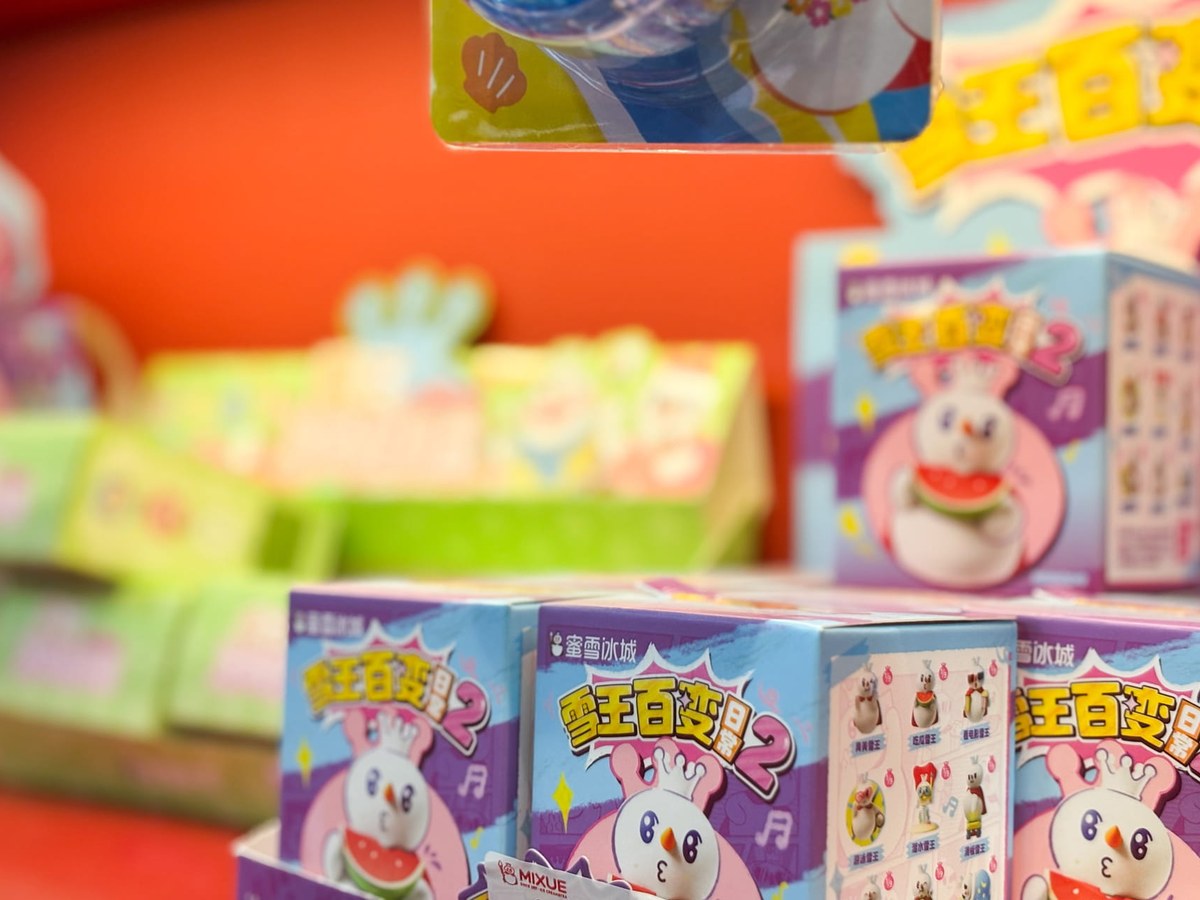
Mixue Bingcheng, the Chinese ice cream and beverage chain with the largest store count in China's beverage retail category, opened a new format store in a bustling Guangzhou neighbourhood in December 2025. The first floor sells the usual Mixue product range, soft serve, teas, ice creams. The second floor is dedicated entirely to merchandise for Snow King, the chain's red-caped snowman mascot. Blind boxes containing themed Snow King figurines have become a hit with younger shoppers since the format launched.
The pricing differential is the point. Mixue's mainstay soft serve ice cream and drinks are priced at RMB 2 to 8, the affordable mass-market tier that built the chain's volume. Snow King blind boxes can sell for more than RMB 20 each. The unit economics of selling a single blind box are more attractive than the unit economics of selling four ice creams. The blind box also requires no refrigeration, no perishability management, no per-store kitchen capacity. The margin structure is fundamentally better.
This is the second time in eighteen months that a Chinese consumer brand has shown the Asian operator playbook for IP commercialisation working at scale. Pop Mart's Labubu was the first. Labubu transformed Pop Mart from a relatively niche designer toy retailer into a global character IP business with theme park ambitions and licensing revenue that operates on completely different unit economics than its original product line. The Labubu blueprint included blind box scarcity mechanics, collaboration drops, anime tie-ins, and the careful cultivation of a character that could carry merchandise revenue across multiple product categories.
Mixue has been studying the same playbook deliberately. The Snow King character was introduced in 2018, a deliberate creation rather than an organic brand asset. An animated series starring the character was released in 2023, building narrative depth before the merchandising push. When Mixue listed in Hong Kong in March 2025, the company committed HKD 395 million, approximately 12 percent of the proceeds it planned to raise, to investments in IP-related businesses. The IP strategy was funded into the company's listing prospectus as a discrete growth pillar, not as a marketing tactic.
Since 2025, large-format Mixue stores selling Snow King merchandise have opened across China, including Guangzhou, Zhengzhou in Henan, and Chongqing. Each of these stores generates merchandise revenue that contributes a different revenue profile than the standard Mixue location. The flagship format is also doing something else important. It is creating the physical experience that allows Snow King to graduate from product mascot to genuine character IP, with the kind of consumer affection that supports long-term commercial development.
Mixue's broader competitive context makes the IP move even more strategically necessary. China was home to about 660,000 beverage stores in 2023, and the category is fiercely competitive. Mixue had the top market share that year, but its store count growth came with an uncomfortable other number. Closures rose about 60 percent in 2025 to around 2,500 stores. The category is consolidating. The operators who own the locations are not necessarily the operators who keep the locations open. Differentiation through product alone is increasingly difficult when every chain is selling broadly similar beverages at broadly similar price points.
Mascot IP gives Mixue a moat that competitors cannot easily copy. Other beverage chains can match the menu. They can match the pricing. They cannot easily create a character with the consumer affection Snow King has accumulated over seven years of deliberate brand building. The character is now the differentiator. The drinks are the foot traffic generator. The merchandise is the margin driver.
Malaysian F&B operators reading this should pause on the obvious question. Why do almost none of them have anything resembling a mascot IP strategy?
The Editor's Note
If you are reading this and the pattern fits your business — start the conversation before the conversation starts itself. editor@unpublished.my.
The reasons are mostly structural. Malaysian F&B operators tend to think of their brand as the chain name and the food itself. The idea that a separate character could be developed as a long-term IP asset is not part of the standard playbook. The investment horizon for IP development is longer than the operating horizon of most Malaysian F&B SMEs. The capability to design, animate, and commercialise a character requires creative resources that most Malaysian F&B operators do not have in-house and have not historically procured externally.
Each of these reasons can be reconsidered. The bigger Malaysian F&B operators, Secret Recipe, Mamak chains with national footprints, the larger bubble tea brands, the established kopitiam chains, all have the customer base and brand foundation that would support an IP strategy. The capability to develop a character can be procured from any of the established Malaysian or regional animation studios. The investment is modest compared to the marketing budgets these chains already deploy on conventional advertising.
What is missing is the strategic conviction that character IP is worth doing. Most Malaysian F&B operators treat marketing as a function of product promotion. The Pop Mart and Mixue templates show that character IP, properly built, is a separate revenue stream that compounds with the underlying product business but does not depend on it. The customer who buys a Snow King blind box at a Mixue store will also buy ice cream. The customer who buys ice cream may not buy a blind box, but the existence of the blind box product line raises the brand's perceived value across the entire customer relationship.
There is also a regional opportunity Malaysian operators should consider. Malaysian character IP that travels across Southeast Asia, leveraging the cultural and linguistic proximity of Indonesia, Singapore, Brunei, southern Thailand, and parts of the Philippines, could establish category positions that are not currently being captured by anyone. The vacuum is real. The market for affordable, locally-resonant character IP across Southeast Asia is not currently being served by the global Japanese, Korean, and Chinese giants who dominate the premium tier.
Mixue is showing what Chinese F&B IP commercialisation looks like at scale. Pop Mart showed what Chinese character IP scaling looks like more broadly. The next twelve to twenty-four months will see more Asian operators trying versions of the same playbook. The Malaysian operators who are still treating mascot development as a cosmetic exercise rather than a strategic revenue pillar are missing the category shift that is already underway.
The first floor of the Guangzhou flagship sells ice cream. The second floor sells Snow King. The economics of the second floor are why Mixue listed at the valuation it did. Read it as a category lesson, not as a Mixue update.